Carbon Footprint: An Environment-Focused STEM Math Project
A Real-World Project Where Students Use Math to Measure Impact
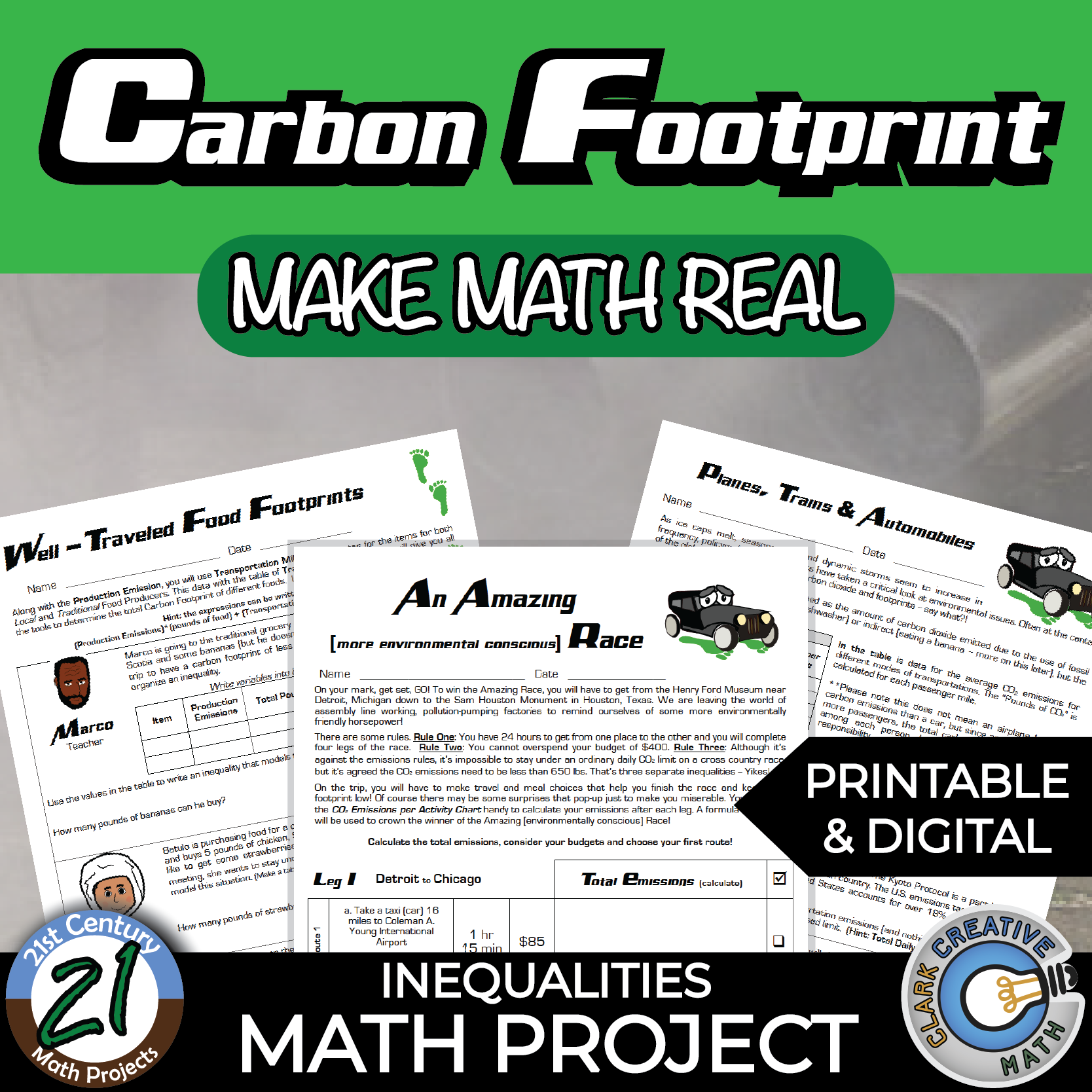
Carbon Footprint is an environment-focused STEM math project where students calculate and compare emissions, analyze tradeoffs, and propose realistic changes backed by mathematical evidence.
Our carbon footprint STEM project helps students connect math to real life by analyzing everyday choices and estimating environmental impact. Students interpret data, compare scenarios, and use numbers to support decisions.
Suggested Grade Level: 6–10 (middle school through early high school)
Best for: Ratios, Percents, Data Analysis, Measurement, Mathematical Reasoning
How This Carbon Footprint STEM Project Works
Students explore what a carbon footprint is and why it matters. Then they move into the math: using data and scenario-based information to estimate emissions from daily activities and choices.
Instead of treating environmental topics as “just science,” students use mathematics to quantify impact, compare options, and defend recommendations.
What Students Do
- Analyze scenarios tied to transportation, energy use, and everyday decisions
- Calculate and compare emissions using provided data
- Use ratios and percents to interpret impact
- Make recommendations based on evidence
- Communicate reasoning through written explanations or discussion
Skills Students Practice
- Ratios, proportions, and percent applications
- Interpreting data tables and graphs (as applicable)
- Estimation and modeling with real-world quantities
- Comparing options and evaluating tradeoffs
- Defending conclusions with mathematical evidence
Why This Environment Math Project Hooks Students
Environmental topics naturally spark conversation. Students have opinions, questions, and strong reactions — which makes this project a powerful way to practice math through meaningful context.
Because students are measuring real impact, they’re motivated to think carefully, check their work, and justify their recommendations.
When to Use This Project
- During an environmental science crossover unit
- As an end-of-unit performance task in math
- For Earth Day, Earth Month, or sustainability lessons
- As a real-world modeling project week
- Anytime you want math + STEM connections that feel authentic
More Real-World Math Projects
Teachers searching for creative math activities often want something that moves beyond worksheets while still reinforcing meaningful learning. STEM projects like this one help students see math as a tool for understanding the world.
Looking for more real-world math experiences? Browse our full collection of 21st Century Math Projects designed to make students think, collaborate, and apply math like it matters.